


Copper Peptides for Hair Growth: Do They Actually Work?
The short answer
Copper peptides (often listed as GHK-Cu or Copper Tripeptide-1) are tiny messengers that talk to the cells in your scalp. Instead of coating your hair, they send signals that tell those cells to repair damaged tissue, make more collagen, calm inflammation, protect against everyday damage, and keep the cells that control your hair growth cycle active. Together, that helps create a healthier home for your hair to grow from.
Early lab research looks promising, but there's still very little research in people showing they regrow hair on their own. Most people notice a healthier-feeling scalp first, and any visible change in thickness takes a few months.
They also work differently from keratin peptides. Copper peptides send signals, while keratin peptides give your hair the building blocks it's made of.
See the research at a glance
Updated 2026


If you've been reading up on hair or skincare lately, you've probably heard about copper peptides, usually labeled as GHK-Cu or Copper Tripeptide-1. They've built a reputation for helping hair look fuller, improving scalp health, and even reducing shedding. But like any buzzy ingredient, it's worth asking a few questions first. What are copper peptides, how do they work, and what does the science say about whether they help with hair loss or hair growth?
What Are Copper Peptides?
Copper peptides are small pieces of protein attached to copper, a mineral your body needs. Being attached to a peptide makes the copper easier for your body to use. The best-known copper peptide is GHK-Cu, which researchers have studied for decades for its role in healing wounds and renewing skin, and more recently, for its effects on hair.
In hair care, copper peptides work as messengers. They don't just sit on top of your hair. They reach the cells in your scalp and hair follicles and help with the work that keeps hair healthy, like protecting cells from damage, making collagen, and keeping follicles working well.
Research on peptides for hair is still growing, but studies suggest copper peptides may help create conditions that lead to stronger, healthier-looking hair.
| What Copper Peptides Do | What the Research Says | What to Realistically Expect |
|---|---|---|
| Help keep the cells that control your hair growth cycle healthy | Lab studies found AHK-Cu helped those cells multiply and helped hair follicles grow longer | A healthier scalp and better-feeling hair within 4 to 8 weeks |
| May improve blood flow that brings nutrients to your follicles | Wound healing studies suggest they help repair tissue, which may help the scalp too | Visible changes in thickness may take 3 to 6 months of steady use |
| Help calm inflammation that can throw off your hair growth cycle | The early evidence looks good, but studies in people are still limited | Hair that feels fuller and stronger, likely because the strands are better conditioned |
| May switch on genes tied to repair and protection | Data suggests GHK-Cu helps keep follicles healthy, but it doesn't prove new hair growth | Best results come from using it once a day on a clean scalp |
| Work well alongside minoxidil and other treatments | People often say their hair feels fuller and stronger with regular use | Rethink your routine if you don't notice a difference after 6 months |
A lot of the interest in these ingredients comes from wider research into peptides for hair growth and how they affect the follicle and scalp.
This guide pulls together the most useful research so you can separate hope from hype and decide whether copper peptides belong in your hair care routine.
The Science Behind Copper Peptides
You don't need a chemistry degree to use copper peptides, but knowing the basics helps explain why they've become so popular in hair care.
Copper helps your body do a lot of things. It helps build connective tissue, protects cells from damage, and helps cells make energy. But copper doesn't always move easily through the body on its own. When it's attached to a peptide, cells can recognize it and use it more easily, which helps them do the work that keeps skin and hair healthy.
Regular conditioning ingredients coat your hair strands. Copper peptides work differently. Think of them as messengers that tell your cells to do the everyday work of keeping tissue healthy. That's a big reason researchers studying wound healing, skin renewal, and hair have been paying attention to them.
This matters for hair because your follicles depend on cells constantly talking to each other. Healthy follicles also need a balanced scalp, enough nutrients, the right building blocks, and a steady growth cycle. Copper peptides may help with several of these at the same time, which is why they're getting studied more and more for hair health.
Scientists have found several copper peptides, and each one has its own structure and research focus. GHK-Cu gets the most attention in hair care research.
What Is GHK-Cu?
If you've looked into copper peptides, you've almost certainly seen the name GHK-Cu. People often use "copper peptides" as a general term, but GHK-Cu is one specific peptide. It's made of three amino acids (glycine, histidine, and lysine) attached to copper.
Scientists first found GHK in human blood in the 1970s. Since then, it's become one of the most studied copper peptides because of how it helps cells communicate and keep tissue healthy. On beauty product labels, GHK-Cu usually shows up as Copper Tripeptide-1.
Most of the published research on copper peptides and hair looks at GHK-Cu or a close relative called AHK-Cu. Researchers have studied both for how they might help keep follicles and the scalp healthy and support normal hair growth.
What Makes Copper Peptides
Unique for Hair?
Hair follicles are always changing. They go through three phases: growing, slowing down, and resting. Understanding this cycle is key if you want to make a real difference in how thick your hair is or how much it sheds.
Copper peptides are linked to hair benefits in a few ways. First, they've been shown to help the cells at the base of the follicle that control the growth cycle. One well-known study found that AHK-Cu, even in very small amounts, increased the number of these cells and helped follicles grow longer. Copper peptides may also improve blood flow, which brings nutrients to your follicles. On top of that, they may help your body make collagen and elastin (the proteins that keep skin firm and springy) and help calm inflammation. All of this adds up to a better setting for healthy hair growth.
Some research even suggests copper peptides may switch on genes tied to repair and protection. That doesn't prove GHK can grow new hair, but it does suggest it could help keep follicles healthier.
What the Research Shows
The science on copper peptides and hair growth is promising, but it's still developing. The strongest evidence comes from studies on human hair follicles in the lab. In one often-cited 2007 study in the journal Archives of Pharmacal Research, AHK-Cu helped follicles grow longer and increased the number of cells that help control hair growth. It wasn't a study in people, but it's solid evidence that copper peptides can directly affect hair follicles.
Other research offers more indirect support. A well-known wound study in rats found that GHK-Cu helped wounds heal and tissue repair itself, which suggests it may help keep the scalp healthy too.
Overall, there's no clear proof yet that copper peptides regrow hair. But they may still help your scalp and hair by creating a more stable scalp environment, which is more and more linked to the balance of tiny organisms that live on your skin. Many people who use copper peptides regularly say their hair feels fuller and stronger, though that's likely because the strands are better conditioned, not because new follicles are forming. And since copper peptide serums are usually light and water-based, they work well alongside minoxidil and other treatments.
How Are Copper Peptides and
Keratin Peptides Different?
Copper peptides and keratin peptides are both exciting areas of hair science, but they help your hair in very different ways. They're both peptides, yet they play different roles in the follicle. As we mentioned earlier, copper peptides like GHK-Cu are messengers that send signals to your cells.
Keratin peptides are building blocks. Your hair is mostly made of keratin, the protein that gives it strength, stretch, and bounce. Keratin peptides are small pieces of that protein, and they supply the materials your body uses to keep hair strong. So while copper peptides focus on sending signals, keratin peptides go straight to the protein your hair is made of.
Here's an easy way to think about it. Copper peptides help the follicle's communication system, while keratin peptides help build the hair itself.
Even though they work differently, both have value. Healthy hair depends on lots of things working together, which is why many advanced hair care formulas pair peptides that complement each other instead of relying on just one.
A healthy hair cycle needs good signaling between cells, the right building blocks, enough nutrients, protection from damage, and a balanced scalp. Combining ingredients that work well together lets a formula help your hair in several ways at once.
The Delivery Problem
To reach the follicle, copper peptides have to get through your skin. Some of it does soak in, but not much. That's why you have to apply them every day and keep going indefinitely. If you stop, the benefits stop too. They also don't mix well with vitamin C and most acids, which can limit what else you use in your routine.
Keratin peptides you take by mouth work another way. IFP-131™ reaches your follicles through your bloodstream instead of through your scalp. That means two capsules a day instead of a daily scalp routine. In a 90-day clinical study, it reduced shedding by up to 47%.*
You don't have to pick one or the other. But if you're reading this because you want thicker hair without adding a permanent step to your scalp routine, that's the comparison worth making.
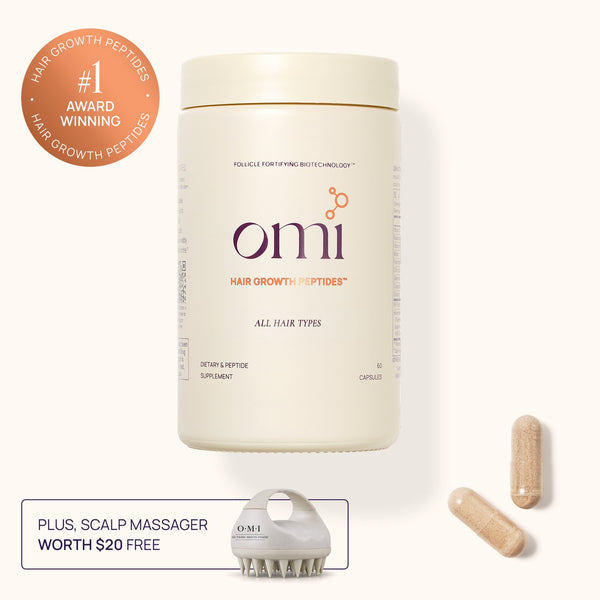
OMI Hair Growth Peptides
Thicker, Stronger Hair in 90 Days. Clinically Studied.
100% Drug & Hormone-Free
From $77/monthwith subscription
Shop nowSkip, pause, or cancel anytime · 90-Day Good Hair Day Guarantee
Could Your Hair Benefit
from Copper Peptides?
Possibly. If you're already using another hair loss treatment like minoxidil, copper peptides can help keep your scalp healthy and make the treatment easier to tolerate. They can also pair with stronger treatments like microneedling, acids, or retinoids. Just space out when you apply each one so your scalp doesn't get irritated or sensitive. A few practical tips:
- Use it every day, once a day, on a clean scalp.
- Apply it after your other treatments, not before.
- Focus on thinning areas like the crown, part, and hairline, and gently massage it in.
- Less is more. Most serums only contain a small amount of Copper Tripeptide-1, and it doesn't take much to work.
It usually takes about four to eight weeks to notice a healthier scalp and better-feeling hair. Visible changes in thickness can take three to six months. That's simply how long your hair's natural cycle of growing, slowing down, and resting takes.
Sticking with it is one of the most important parts of using peptide hair care. Copper peptides don't give you an instant cosmetic change. They help the natural processes in your scalp and follicles, and those need repeated use over time to make a difference. A steady routine gives them the time they need to work.
We've put together a guide on what changes you might notice when you use peptides the right way. If you don't see or feel a difference after six months, it may be time to rethink your routine.
A few important notes: Most people handle topical GHK-Cu well, and side effects are usually mild, like brief tingling or slight irritation. Copper peptide serums are often blue because of the copper, but they won't tint your hair, and any leftover color should fade once the product dries.
If you have a condition that affects how your body handles copper, like Wilson's disease, or you already use several products with copper in them, talk to a doctor before adding another one. As with any new product, do a patch test and start slowly, especially if you have sensitive skin. And check with your doctor if you're pregnant or breastfeeding.
The Takeaway
Research suggests copper peptides like GHK-Cu and AHK-Cu can help keep hair follicles healthy, and the results so far are promising. Still, most of the strong evidence comes from the lab, and studies in people are limited. Think of copper peptides as a supporting player, not the star of the show. They can help create a healthier place for hair to grow, especially when you use them with proven treatments as part of a full scalp and hair care routine.
OMI Hair Growth Peptides
Thicker, Stronger Hair in 90 Days. Clinically Studied.
100% Drug & Hormone-Free
From $77/monthwith subscription
Shop nowSkip, pause, or cancel anytime · 90-Day Good Hair Day Guarantee
Frequently Asked Questions
*Based on a 90-day clinical study in women with stressed hair. Hair shedding was evaluated using a dermatologist-administered hair pull test. Results reflect reduced shedding, not hair regrowth. Individual results may vary. See our Clinical Trials page for full results.
These statements have not been evaluated by the Food and Drug Administration. This product is not intended to diagnose, treat, cure, or prevent any disease. If you are pregnant, nursing, taking medication, or have a medical condition, consult your physician before using any dietary supplement.


